
Four things keep going wrong. They look like four separate problems, which is why they get separate owners — strategy to the executive committee, governance to risk, tool access to IT, return on investment to finance. They are not four problems. They are one, arriving in four stages, and each stage produces the next.
I see them in different sectors, at different sizes, in organisations with very different levels of technical maturity. The specifics change. The shape does not.
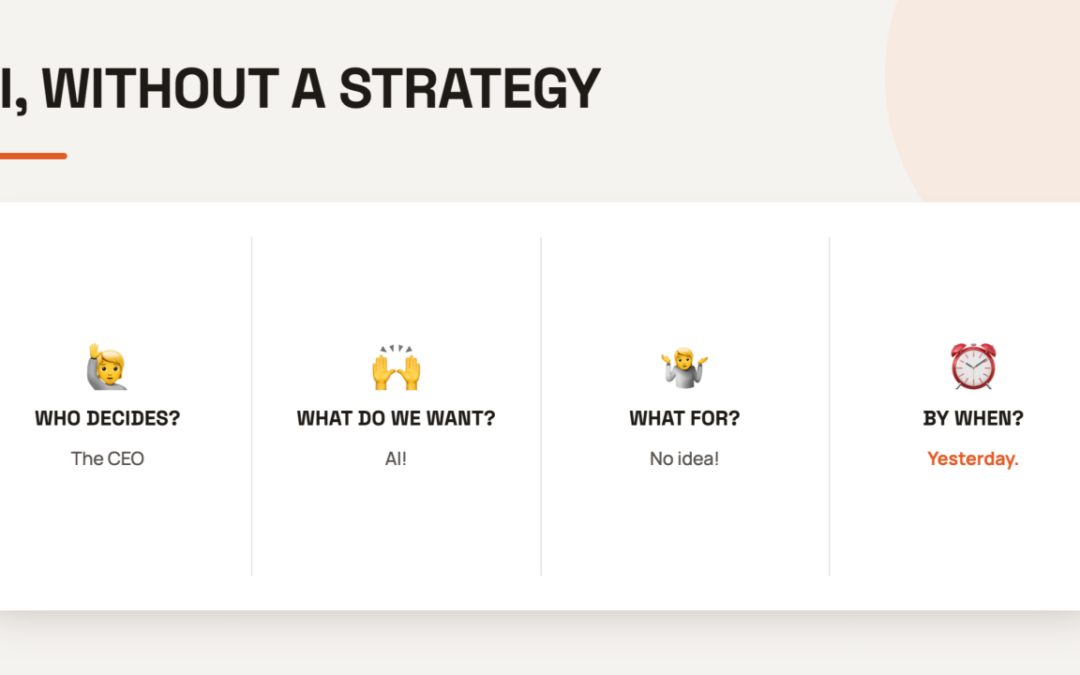
It all starts with a mandate that contains no direction.
The objective gets dropped in organisation decentralised and content-free: use AI. Every team interprets it locally, because nothing tells them what it is for. A bunch of initiatives start. None of them are connected. Each is defensible on its own terms, collectively it does not add up though.
This is not stupidity, and it is worth saying so plainly. Leadership is under real pressure to demonstrate movement, and a broad mandate is the fastest available way to generate visible activity. The cost of the ambiguity only appears much later, by which point it is nobody’s fault in particular.
The signs piling up are not subtle. Meta became the first major technology company to formally tie performance reviews to AI usage, with “AI-driven impact” now a core expectation for every employee. Microsoft has told staff internally that AI is no longer optional and linked it to reviews. NVIDIA’s chief executive responded to reports that some managers were telling employees to use less AI with a single word: “insane.” Meanwhile 39% of organisations report having no formal plan to derive revenue from AI tools at all, and 48% describe their adoption experience as a massive disappointment (Writer, 2026 enterprise survey).
There is even a word now for the purest expression of a mandate without a purpose: tokenmaxxing — pushing employees to consume as many tokens as possible, on the theory that usage signals productivity. In reality, this drives down quality and results in poor performance
None of this is a strategy. And with no strategy, there is nothing for a central function to enforce. Which produces the second stage.
Then the centre of excellence turns out to be blind.
Either it was never built, or it exists and has no view of what is actually running. The second case is considerably more dangerous, because it produces confidence. There is a governance structure, a workstream, a steering committee, a slide with a maturity model on it. Underneath, there is no telemetry at all.
The most revealing number I have seen on this comes from vendor research, so treat it accordingly, but the shape of it matches what I encounter. Asked whether they had visibility into AI use in their organisation, 92.4% of executives said yes. Among directors — the people closest to the work — 76.3% (Larridin, State of Enterprise AI 2026).
The gradient runs the wrong way. The further from the actual work someone sits, the more confident they are that the organisation knows what is happening. It is not merely that management disagrees about what is going on. They disagree about whether they know.
Separately, 45.6% of organisations report that their workforce AI adoption rate is simply unknown.
A central function that cannot see cannot offer a usable path. So people find their own. Which produces the third stage.
Access arrives without passing through anyone.
Model access does not come through an enterprise agreement. It comes through personal accounts, individual subscriptions, team-level cards, tools bought after the last renewal cycle closed. Nobody decided this. It is the entirely predictable consequence of instructing people to use AI without giving them a sanctioned way to do it.
Research from one AI security firm found that 64.5% of activity on personal-tier AI accounts is business use rather than personal use — reaching 80.2% on one free tier. People are not planning holidays on these accounts. They are writing client emails, summarising meetings, and debugging code (Harmonic Security, AI Usage Index, May 2026).
The security exposure is the part everyone leads with, and it is real. But two other consequences matter more to a business leader and get discussed far less.
The first is contractual. Personal plan terms differ materially from what procurement would have negotiated. Everything processed through them has been handled under terms that nobody at the organisation ever reviewed, let alone accepted.
The second is a capability leak. When that person leaves, they take the accumulated context with them — the prompts that worked, the patterns they built, the model memory shaped around their part of the business. The organisation cannot recover any of it, because it never held it in the first place. The work happened. The learning left with the individual.
Which brings the sequence to its arithmetic conclusion.
The gains never aggregate.
Individual productivity improvements are real and sometimes dramatic. They do not appear anywhere above the individual. The organisation has super-users producing genuinely extraordinary output, and no mechanism by which any of it changes a delivery timeline, a margin, or a capacity constraint.
McKinsey finds 88% of organisations using AI in at least one function, and fewer than 40% having scaled beyond pilot. MIT’s research puts the share of generative AI pilots that fail to move past the experimental phase at 95%. PwC’s 2026 CEO survey found 56% of chief executives reporting they had received nothing from their AI efforts.
Those numbers are usually presented as evidence that the technology underdelivers. I would read them differently. The gains do not aggregate because nothing was ever designed to aggregate them. There was no strategy defining what they were for. There was no central capability positioned to spread what worked. There was no visibility into who was doing what, so the super-users were never identified, and what they had learned was never captured.
The fourth pattern is not a fourth failure. It is the sum of the first three.
Fixing any one of them in isolation does not work, and this is why so much remediation effort produces so little.
Improve governance without a strategy and you build a control function with nothing coherent to control. Consolidate tool access without visibility and you standardise on the wrong things while the actual usage moves elsewhere. Measure return on investment at the end of a chain that was never designed to produce one, and you will conclude — reasonably, and wrongly — that the technology does not work.
The organisations I see with all four patterns are convinced they have an AI problem. They have an operating model problem that AI made visible and expensive. That distinction determines almost everything about whether the next twelve months produce anything at all.
Which suggests a question worth asking before the next initiative is approved.
If you asked four people in your organisation what your AI programme is actually for, how many different answers would you get?
Most executives know the answer to that immediately. The discomfort is the useful part.
Alexandre Castaing is Managing Director of Axon Advisory & Consulting, working with supervised financial entities in Luxembourg on digital resilience, AI governance and regulatory compliance.
#AIStrategy #AIGovernance #DigitalTransformation #Leadership #EnterpriseAI #ShadowAI #OperatingModel