
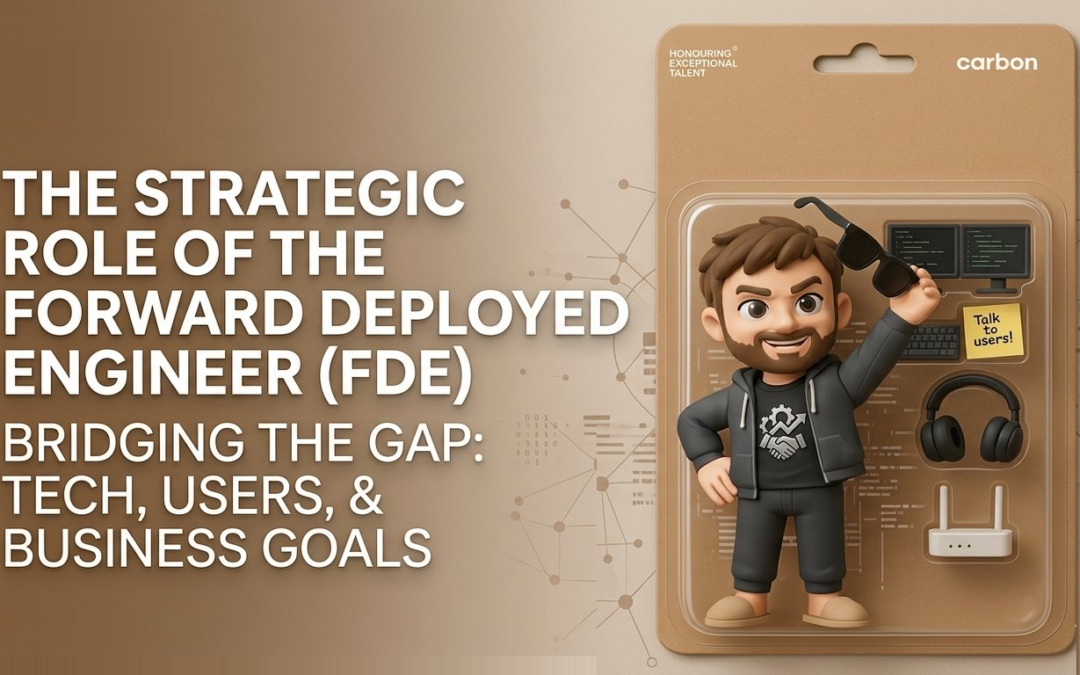
A few months ago, nobody knew what a Forward Deployed Engineer was. Today, it’s the most sought-after tech role on the planet.
Job postings for this profile surged +729% in a single year — from 643 listings in April 2025 to over 5,300 by April 2026, according to Indeed. Substack
This isn’t a trend. It’s a structural signal.
So what exactly is a Forward Deployed Engineer?
The concept was pioneered by Palantir over a decade ago. Their bet was simple was simple: stop sending decks. Send engineers.
The FDE embeds directly inside the client’s team — learning their systems, mapping their broken workflows, and building AI-powered solutions on the spot, in real time, alongside the people who will actually use them.
Part engineer. Part consultant. Part product owner. Fully accountable for shipping.
Problems that sat in PowerPoints for years? Solved in weeks. No MVP theater. No handoff decks. Just working systems.
Why is it exploding now?
AI shifted the constraint. The bottleneck for enterprise AI adoption nodays is no longer model capability. It’s organisation desgin contraints and deployment capability.
And deployment capability is an engineering discipline — not a procurement decision, not an 80-slide report, not an organisational design workshop.
The gap between “this works in a demo” and “this works in your specific environment, with your data, inside your compliance framework” is measured in engineering hours spent on the client’s systems. That’s exactly what the FDE is built to close.
The major players have understood. They’re repositioning fast.
OpenAI announced its “Frontier Alliances” — structured multi-year partnerships with BCG, McKinsey, Accenture, and Capgemini — with its own FDEs working alongside consulting teams inside client engagements. Yahoo Finance
In March 2026, Accenture launched a dedicated forward deployed engineering practice in partnership with Microsoft to help organisations scale AI across enterprise environments. Blogs & Resources
EY is also actively hiring Forward Deployed Engineers — senior AI engineers working directly within client teams — to meet growing demand for end-to-end AI support. EY
Anthropic — backed by Blackstone, Hellman & Friedman, and Goldman Sachs — launched a parallel $1.5 billion joint venture, with engineers embedded directly inside portfolio companies. MarkTechPost
This is no longer a competition between AI labs and consulting firms. It’s a convergence. And the FDE is the interface.
What this actually means for consulting
The premium on talent is no longer resting on analytical horsepower alone — it’s shifting decisively toward hybrid profiles that can combine advisory with technology and large-scale execution.
I see three concrete implications:
1. The deliverable has changed. A report is no longer a deliverable. A system in production is. Clients want measurable outcomes, not recommendations they have to implement themselves.
2. The consultant profile is being rewritten. McKinsey — via QuantumBlack — now requires candidates with 8+ years of hands-on software engineering or infrastructure experience, combined with a background in AI or applied statistics. That’s a fundamental shift in MBB recruiting DNA. Jawlah
3. Boutiques have a narrow window. Large firms are slow to reorganise. The FDE model structurally advantages smaller, specialised advisory outfits — those who can embed deeply, move fast, and own outcomes rather than handoffs. The question is whether they’ll seize it.
Some boutiques didn’t wait for the signal
Here’s what often gets lost in the FDE conversation: the scarcity problem.
Experienced FDEs command salaries between $170,000 and $300,000+. They’re going to Palantir, OpenAI, Anthropic. Not to mid-size enterprises trying to operationalise their AI strategy. Substack
Which means most organisations face a structural paradox: they need FDE-level outcomes — embedded, hands-on, accountable delivery — but they cannot compete for FDE-level talent.
This is the gap a well-structured boutique advisory firm can fill. Not by mimicking the FDE hire, but by offering something more complete: strategic framing + embedded technical delivery + regulatory fluency — all in one engagement model.
At Axon Advisory, this isn’t a pivot we’re making in response to the FDE wave. It’s the model we’ve been running for many years — embedding with clients across Digital, Risk & Compliance, and Resilience, building systems that stay in production long after the engagement ends. The FDE wave isn’t disrupting what we do. It’s finally giving it a name.
The bigger picture
For 30 years, consulting sold clarity. Strategy. Direction. The new buyers want something different: they want someone who stays in the room until it works.
That’s not a small shift. That’s a redefinition of what value looks like in professional services.
The firms that adapt won’t just survive this transition. They’ll own the next decade of enterprise AI deployment.
The ones that don’t will keep sending decks.
What’s your take — is the FDE model a threat to traditional consulting, or an evolution of it?