
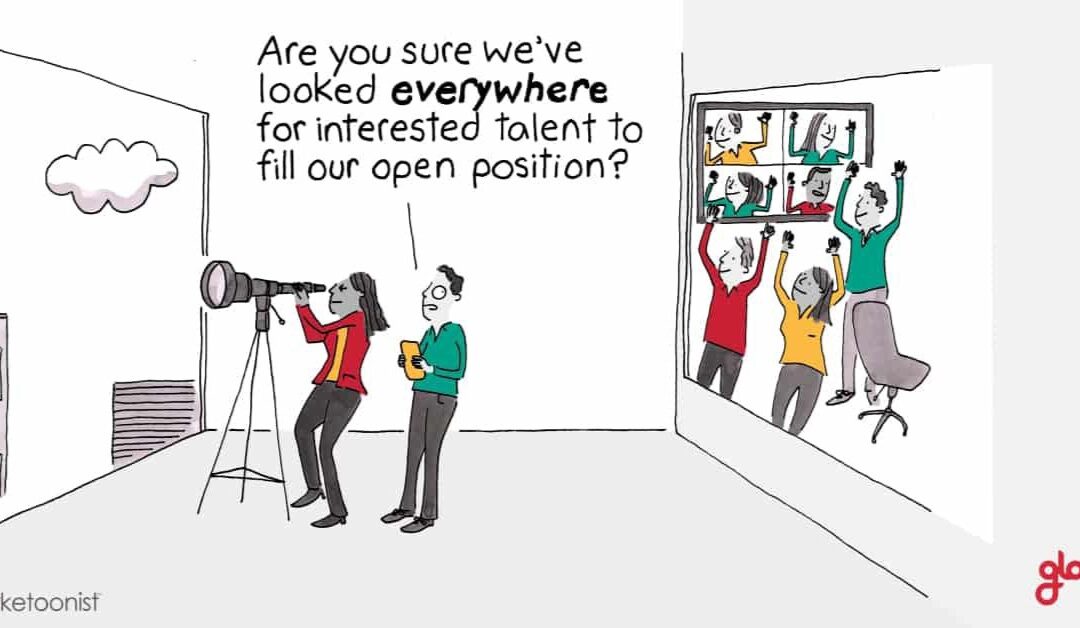
Organisations are paying half a million dollars for AI talent on the open market. The capability they actually need is already on their payroll — and most of them are about to make it redundant.
There is a strange contradiction playing out in organisations right now.
On one side, the market for AI talent has gone vertical. Job postings for Forward Deployed Engineers — the profile that embeds inside a client’s systems and ships working AI, not slide decks — surged more than 700% in a single year. Experienced ones command $170,000 to $300,000 and above. Palantir, OpenAI, and Anthropic absorb them as fast as the market produces them.
On the other side, in those same organisations, the finance function is modelling how many roles AI will let them cut. The workforce is a cost line to be optimised down, while AI talent is a scarcity to be chased at any price.
Both movements are happening inside the same companies. And both are, for most of them, a mistake.
Start with the talent chase, because it rests on a category error.
The FDE boom is a supplier-side phenomenon. It is the model AI vendors and specialist firms use to bridge the gap between what a model does in a demo and what it does inside a client’s messy, regulated environment. If your business is building frontier AI or deploying it into hundreds of client environments, you need this profile, and you should pay for it.
That describes a narrow slice of the economy. For everyone else — the banks, the asset managers, the industrial firms, the overwhelming majority that adopt AI rather than build it — trying to copy the FDE playbook as a hiring strategy is neither possible nor necessary. You will not win a bidding war against firms paying half a million dollars a head, and you do not need a permanent one on staff.
But this is where the argument is usually taken one step too far. Concluding that you therefore need no external technical capability at all is equally wrong.
Two capabilities are in play, and they differ less by subject than by depth and permanence. The first is business judgment: knowing which processes should be automated and which should not, where the exceptions live, what a correct outcome actually looks like in your context. That comes from years inside the business. It is permanent, it belongs to your organisation, and it cannot be bought.
The second is the ability to turn that judgment into something that runs — a workflow with explicit rules, a model operating inside defined boundaries, controls that stop a wrong output before it becomes a wrong action. That is an engineering capability, and most adopting organisations need it intensively for a period rather than permanently.
But here is what the FDE phenomenon actually reveals, and it is routinely misread: that profile does not command half a million dollars because its holders write better code. Plenty of excellent engineers are available for far less. It commands that price because the good ones are bilingual — technically deep enough to build, and business-literate enough to understand why an exception exists, what a domain expert means when they say a result “looks wrong,” and how to design something usable rather than merely elegant.
An engineer who speaks only technology does not solve the adoption problem. They relocate it, and hand back a system nobody trusts. Bilingualism is the scarce trait, not technical skill — which is precisely why it is expensive, and why very few organisations can build it internally from scratch.
The mistake is not recognising that you need this capability. The mistake is assuming the only way to get it is to hire it permanently.
This is where the data cuts against the prevailing narrative, and it is worth being precise, because the imprecise version is everywhere.
It is often said that “skills are the barrier” to AI transformation — and the World Economic Forum’s Future of Jobs Report 2025 does find that 63% of employers name skills gaps as their single greatest obstacle. But that figure alone proves nothing about which skills. The revealing part is the hierarchy. When the WEF ranks the capabilities that matter most through 2030, technical skills are rising fast but they do not top the list. Analytical thinking sits first, considered essential by seven in ten employers. Then resilience and adaptability. Then leadership. Then creative thinking. The report’s own conclusion is unambiguous: technology skills are necessary but not sufficient.
There is a reason analytical thinking becomes the number-one skill precisely as AI scales, and it is not a coincidence. When a machine can generate a thousand plausible answers in seconds, plausibility stops being valuable. The scarce capability becomes the judgment to know which of those answers is actually correct — and which one, if acted upon, would quietly cause damage. AI does not reduce the need for human judgment. It raises the premium on it.
And that judgment has an address. It is not abstract, and it is not something you can recruit for on a job board. Knowing that a credit assessment is subtly wrong, that an AML alert is a false positive, that a contract summary has quietly dropped the one clause that mattered — that comes from years of accumulated exposure to how this particular business actually behaves. The people holding it are the domain experts already inside the organisation. Which produces the contradiction in its sharpest form: the capability that AI makes most valuable is concentrated in exactly the population that headcount reduction targets first.
Which brings us back to the contradiction, and to the real antagonist in this story.
The pressure to treat the workforce as a cost line to be cut is not stupidity. It is the entirely rational response to short-term financial incentives. A reduction in headcount shows up in this quarter’s numbers. The erosion of institutional knowledge, the loss of the people who understand why the business works the way it does, shows up years later — and never in a form clean enough to attribute. The market rewards the visible saving and ignores the invisible cost. That is what makes the trap so effective.
But the arithmetic is a trap all the same. Cut the automatable roles without building the capability to supervise and challenge AI, and you lose the domain knowledge that gives your AI deployments their context — and you make yourself dependent on the very external providers whose talent you could not afford. You will have optimised your way into a weaker position.
The organisations that struggle over the next five years will be the ones that asked how many people AI let them remove. The ones that pull ahead will have asked a harder question: where is value moving in our business, and who on our existing team is best placed to move towards it?
That second question has an answer, and in most organisations part of it is already on the payroll. Who those people are, how to recognise them, and — just as important — what they will and will not be able to do on their own, is the subject of the next article in this series. A third will look at what the path from scattered individual use to AI genuinely embedded in business processes actually looks like, and who needs to be in the room to get there.
Alexandre Castaing is Managing Director of Axon Advisory & Consulting, specialising in digital resilience, AI governance, and regulatory compliance for supervised financial entities in Luxembourg.
#FutureOfWork #AIStrategy #Reskilling #Leadership #HumanCapital #DigitalTransformation #WEF